Graduate Faculty – We Need Your News!

Have you been recently published? Have you been asked to speak at a conference? Or to give a presentation? Did you receive and new licenses or certifications? How are you continuing your education? Do you know of any opportunities that your fellow staff members should be aware of? Any recent accomplishments outside the classroom? Any exciting recent career developments or awards? Any of your colleagues receive recognition or awards? Do you have any interesting stories? Our graduate faculty and students want to know!  It inspires and encourages, it helps us celebrate with you, and your success allows us to continue our growth.

Please share your news, photos (if possible), and details with the Director of Graduate Studies Dr. Meyer via email! It will be included in our newsletters and Facebook updates. Click here, and let’s start sharing!

Access to Mental Measurements

Here are a few different options for students and faculty to use for access to Mental Measurements Yearbook.
(Off-campus users should begin their sessions by logging in to the MLC Portal, which then should provide access to the library’s online resources.  They can use the Library link on the portal or navigate directly to the library’s web page.)

1:  From www.mlc-wels.edu/library, click on the “E-Journals” tab above the search box.  Search for mental measurements.  The Titles A-Z search page will be returned, where you can click on the the title Mental Measurements Yearbook (EbscoHost) and from there conduct searches in that resource alone.

2:  From www.mlc-wels.edu/library, click on “Search and Find” on the left side of the page.  Scroll down to Databases/Databases A-Z and scroll down to Mental Measurements Yearbook.  Clicking on the title will take you to the same search screen as in option 1.
3:  Articles from Mental Measurements Yearbook are included in our Discovery tool, which is the default in the search box at www.mlc-wels.edu/library; however, searches in Discovery would need to be quite specific and narrowed down within Discovery in order to find just the resources from Mental Measurements Yearbook.  I would recommend this option in cases where you are looking for more information, in addition to that found specifically in Mental Measurements Yearbook.
If students or faculty should encounter any trouble with this, please refer them to us in the library for assistance.

Opportunities to Publish

At its May 2014 conference, the graduate faculty discussed the need to provide opportunities for our faculty and students to write for a larger audience. Dr. Abrego mentioned that Cabell’s Directories can be useful for finding publications that may match our or our students’ work. Some new MLC-sponsored outlets for publishing will soon be available. Graduate faculty members are encouraged to lead the way, both as authors and in urging students and advisees, both past and present, to contribute. Here is one way you can write for the broader WELS educational and intellectual community.

blog photoIssues in Lutheran Education:  This is a blog that will be published two times each month. The purpose of this blog is to provide a platform for a professional conversation around issues that are important in Lutheran education. This blog is uniquely focused on educational issues as they occur within the Wisconsin Evangelical Lutheran Synod (WELS) and the Evangelical Lutheran Synod (ELS). However, these issues and discussions also apply more broadly to Lutheran education in other church bodies, and to Christian education in general.

The blog content addresses a variety of concerns, both spiritual and secular, that impact the instruction, learning, and culture within all levels of Lutheran education – from preschool through higher education. Discussion centers on topics such as gospel ministry, instruction, leadership, administration, operation, recruitment, retention, outreach, technology, standards, and financing.

Blog authors are educational leaders within the WELS and ELS. Faculty and adjuncts in WELS / ELS higher education, master’s degree graduates, graduate students, and those who hold offices of leadership in the synod are invited to write for this blog in areas of their expertise. Other educational leaders may submit article proposals. Proposals should be submitted according to the guidelines listed elsewhere on this page.

This blog is operated by the Office of Graduate Studies and Continuing Education for Martin Luther College, New Ulm MN. Martin Luther College is the College of Minstry for the Wisconsin Ev. Lutheran Synod, whose mission is to train a corps of Christian witnesses who are qualified to meet the ministry needs of the WELS and who are competent to proclaim the Word of God faithfully and in accord with the Lutheran Confessions and the Book of Concord.

Unsolicited submissions are considered for publication according to the following guidelines:

  1.  The blog must address a topic of interest and application to Lutheran education.
  2.  The blog must accurately represent commonly accepted research, knowledge, ideas, and/or practice.
  3.  Positions taken must agree with biblical principles and reasonable logic.
  4.  All claims must be substantiated and verifiable.
  5.  References and/or online links to supporting literature and research must be provided.
  6.  The blog is suggested to be more than 500 words, but must be less than 750 words.
  7.  The author must be involved with ministry within the WELS or ELS.


All submissions should be emailed to

ISSUES IN LUTHERAN EDUCATION

Continuing Education for Faculty

A high-quality program requires high-quality instruction. The graduate faculty is encouraged to look for ways to improve instruction and grow in knowledge and understanding. If you find a book, workshop, or other opportunity to expand your ability to serve our graduate students, please check with the  to see how we can partner with you in paying the cost. Let’s continue to give the best we have for our students.

MLC’s Credit Hour Policy

MLC has a credit hour policy that has implications for every course – including online graduate courses. Newly adopted federal regulations and Higher Learning Commission policies necessitate MLC specifying common practices and documenting them in course syllabi. This policy affects every MLC course instructor. Please read on to see how if affects you.

In compliance with the credit hour policy, course syllabi will need to be modified to specify how the course fulfills the credit requirements. Online courses must meet the same instructional outcomes as an on-campus course. Below are the parts of MLC’s credit hour policy that apply to graduate courses and a suggested template to use within your course syllabi.

Martin Luther College Credit Hour Policy Definitions: A class hour is defined as 50 minutes. The definitions below refer to the number of class hours during a semester that is approximately fifteen weeks long or an equivalent amount of time for terms of shorter duration. These definitions conform to commonly accepted practices in higher education.

Policy:

  • One on-campus class credit is defined as: 1 class hour of direct faculty instruction per week and 2 class hours out-of-class student work each week.
  • One distance learning or hybrid class credit is defined as: an equivalent amount of instruction and student work leading to equivalent learning outcomes, as required for an on-campus class as defined above.
  • A course offered in a term of less than 15 weeks shall contain the same class hours, preparation time, content, and requirements as the same course or an equivalent course offered over a 15-week semester.
  • One graduate level credit hour is equivalent to an undergraduate credit in regard to the amount of work, but the type of work regularly involves more rigorous standards for discussion and application. In addition to educational activities outlined for undergraduate work (see below), graduate work also includes retrieving, reading, discussing, analyzing, synthesizing, and evaluating empirical research and reports of research; applying research to practice; and conducting and reporting one’s own research.
  • Examples of undergraduate activities: assigned readings; participation in discussions; listening to or viewing required instructional presentations; finding, gathering, and reviewing resources; preparing and sharing papers, projects, presentations; collaboration with classmates around a given task; creating and implementing research projects; preparing for quizzes and examinations; and internships.

Syllabus Requirements
Each course syllabus should include specific information. The section of the syllabus titled “Course Methods” should be changed to read “Course Methods / Credits.” The description in the section should include the following:

According to commonly-accepted collegiate academic practices, success in this course requires work equivalent to an average of 112.5 hours of work. Coursework includes . . . (List the types of activities, readings, assignments, and assessments your students will complete as part of this course.)

All instructors are asked to include the above statement in their course syllabi and submit them to the Office of Graduate Studies by emailing them to J

Benjamin Bain, MS Ed

Benjamin BainAsk 2010 MS Ed graduate Ben Bain what makes his work as principal and teacher at St. John’s in Red Wing, MN, special, and he’s likely to say, “The people I get to work with really make this a special place, and that’s been a real privilege.”

In fact, the congregation, parents and faculty have supported his graduate studies in various ways. The congregation helped pay for some of his credits. Ben adds, “People have said things to me like, ‘It’s good that you’re doing that.’”

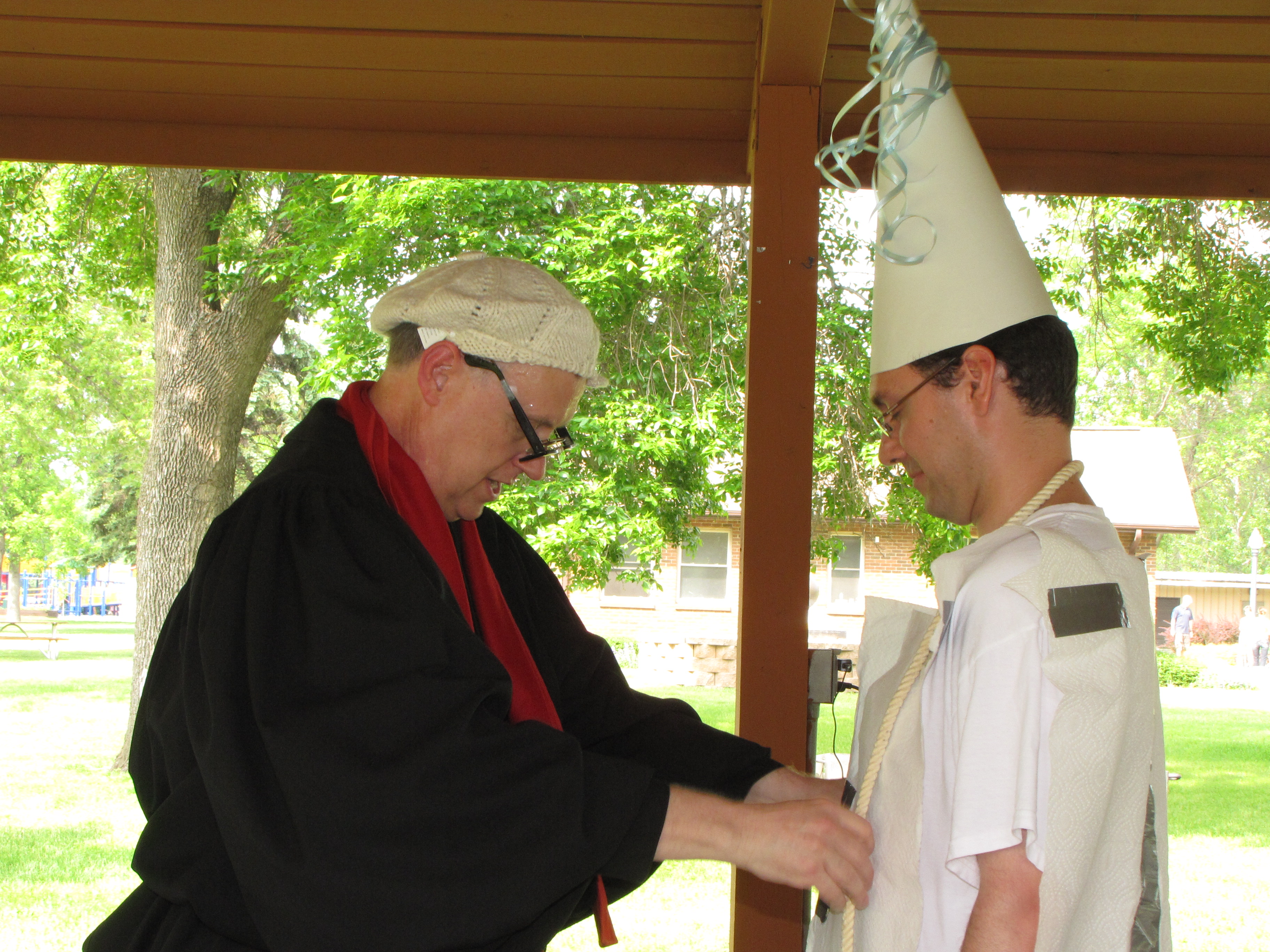
When Ben received his diploma in May 2010, the people he serves celebrated with him. The congregation honored Ben with a reception. In a separate party his pastor, faculty, and staff held a “mock” graduation ceremony. “The party was a bit crazy,” wrote Ben. The pictures show Pastor Loren Lucht in his “regalia” awarding Ben (dunce cap) while the faculty looks on.

Why did Ben choose to get his master’s degree? “I just felt like there was so much more to learn.” He asked himself, “How do I hone those skills? What do I need to do to better help the kids learn?” Ben enrolled in the MLC master’s program in the instruction emphasis.

Ben Bain mock graduation 1Ben found that the MLC master’s program helped him reach his goals right away. “One of the first courses I took was about Reading and Language Arts. When I came back, I began to use a number of pieces. There were things that I had tried in the past that didn’t work out, and now I felt more comfortable on how I can approach it so that I’m not cheating the kids of certain things. And yet I’m giving them the opportunity to grow and learn.”

Ben likes to give his students ownership in the curriculum. He related a Science unit on natural disasters in which the students devised their questions and got to pick what they wanted to learn. Ben taught them how to research, cite references and structure their learning. They did the rest and shared what they learned in power point presentations. Why? “They’re finding more information than what there was in the book in the first place, and they’re more interested in it than just, ‘read this chapter in the book,’” says Ben.

This past summer, the enrollment at Ben’s school took a jump. Its reputation for Christian love and academics is well-known, and when a different Christian school closed, many looked to St. John’s. Ben and his school serve as an excellent example of what continuing education for teachers is all about.

Amy Bryant, MS Ed

Amy Schmeling BryantFamily comes first for Amy Schmeling Bryant(’03), but she also wants to serve her church. With God’s blessing, she has managed to balance them both—beautifully.

Amy serves as a preschool aide and Sunday school coordinator at Salem – Woodbury MN. She also started an additional outreach program at Salem called Smart Start. Working as a volunteer, she holds a music class for parents and children ages 0-5 on Mondays, and a toddler class on Tuesdays.

“My joy is seeing all these young people walking through the doors of our church each week with their parents,” she says. “The exposure we have and the relationships we are able to form with the families in the community have been real blessings. I love working with young children. They give all they have, whatever it is they are doing.”

Amy began taking MLC master’s classes in 2009. “In all honesty, I didn’t start out really thinking about getting a master’s. I took the first class because it was something that interested me. After that I just kept going, and now I’m two classes from finishing my degree.”

Amy chose the Instruction emphasis for two reasons: family and church, not surprisingly. “I wanted to be able to use what I would learn with my children at home,” she says. “And I wanted to be able to be a resource to our church and the ministries we were looking to pursue in the future.”

As far as family is concerned, Amy says her two boys have served as guinea pigs for various new ideas she’s learned—“and very willingly, I might add.”

Her ministry at church and school has been affected by her professional growth as well: “I think it is important to be educated on the changes happening in teaching and instruction today. Knowing about the different methods used around the country helps the preschool program to be as strong as it can be, so that nothing stands in the way of the gospel message we want to proclaim.”

The format of MLC’s program worked well for Amy. “I love the flexibility that the program gives me as a mom,” she says. “I fit the work into the busy schedule we have as a family and am able to work at it when my boys are busy doing other things or after they’re in bed for the night. Of course there are times when that isn’t enough, and my family has been really supportive of the time I spend ‘doing my classwork,’ as my boys would say. It has been pretty neat for them to see that mom still has things to learn too.”

Studying with fellow believers has also been a blessing. “I think the strength that this program provides spiritually has been a huge impact to my faith. I’ve grown in my own understanding of the grace of my Savior. And hearing struggles and joys that other teachers around the country have is so meaningful. It brings everyone together in the work they are doing and encourages people to grow in their abilities because they are working for the Lord.”

The family and church balancing act continues for Amy. While she works on her final master’s courses, her husband, who is a U.S. Air Force pilot, is sometimes deployed, and her two boys keep her very busy. “I love spending time with my family,” she says. “I love seeing my two boys learn new things and play together. We love hiking and exploring as a family and finding new places in the area that we haven’t been before. We also love airports and traveling, and feel comfortable hopping on a plane and heading across the country! My oldest son took his first flight at 16 days old, and since then he probably has over 100 take-offs and landings to his name!”

When her husband returns from his most recent deployment this summer, the family will move to Onalaska, Wisconsin, near La Crosse. And Amy will continue to study. “At the beginning of every class I take,” she says, “I am always nervous about the time I have to commit in order to get out of the class what I’d like. Then I read the introductions of everyone else in the class, and they are just as busy and just as anxious about spending time at their ministries and with their families. Somehow we all make it through.”

As she packs boxes, she says, “I am excited to get involved with the ministries at our church in Onalaska. I know that God has a plan for how I can serve in our next stage in life.”

(Article written by Laurie Gauger)

Rachel Burgess, MS Ed

Rachel Burgess Preschool Director Trinity-CaledoniaJuly 8, 2010, was an important day for Rachel Perry Burgess ’02. She handed her comprehensive examination to Director of Graduate Studies John Meyer, marking the culmination of her graduate work at Martin Luther College.

Emphasis: Of the three emphases—instruction, special education, and leadership—Rachel opted for leadership because the classes seemed most applicable for her work as an ECE director. She says she didn’t necessarily start out trying to get a degree, but just wanted to take courses that were interesting and practical. (Cognitive psychology is just one of the courses she really loved.) When she realized she was well on her way to her degree, she decided to finish the program.

Her call: Rachel is currently the director of an ECE at Trinity-Caledonia WI, where she teaches children ages 3-5 five mornings a week. Previously, she served in ECE ministries in Baton Rouge LA, La Crescent MN, and Inver Grove Heights MN; as a kindergarten teacher in West Allis WI; and as director of a KinderCare Learning Center in Brookfield WI. (Why so many places? As the wife of a seminary student and new pastor, she moved quite a bit.)

Flexibility: The flexibility provided by the online facet of the program was important to Rachel. “I knew I’d be moving three years in a row, so it was good to have it online, because I could do it anywhere. It was nice to be able to work on Saturdays. My husband is a pastor, so he’s busy on Saturdays, and I could set my schedule according to his. Also, if we were planning a camping trip, I could work ahead. I also worked at the YMCA till 10 pm, and I could work online after that or early in the morning.”

Community: She also appreciated the online community. “Almost every course starts with introducing yourself. Profs make sure that everyone is communicating and working together. And most students had a WaterCooler line on Moodle, which is for more personal things: carpools, recipes, baby news, calls, that sort of thing.”

Applicability: “The projects weren’t just assignments. They were applicable right away. And most of the profs were open to you tweaking the assignments to make sure that they fit your situation.

“My courses on assessment and administration were directly applicable. I immediately made small changes in my class the very next day, and now that I’m done with the program, I want to go back through my notes and see what I want to implement first. There are so many things, but which do I want to do first?”

Variety: Some may wonder whether coming back to MLC means they’ll just get more of the same. Rachel says, “No! I only had one of these profs before—Dr. Menk. Everything changes. You have a variety of people with different pasts, including profs from WLC and profs who’d never even set foot on the MLC campus before. There’s a variety of new methods and perspectives—and even the content is different. The profs are not teaching the same thing you learned in undergrad work.”

Rigor: “People who’ve taken courses elsewhere say that MLC courses are harder, but I don’t think that’s a bad thing. I didn’t feel overworked, but I did have to work. It stretched me, and there were times when it was a lot, but it is a master’s program.”

Professional growth: “The biggest change in my ministry would be that I have a better communication system with the families and communities I serve. Open-ended communication with parents affects so many things. I’ve also found that parents are looking for their children’s teachers to be seeking more education.

I’m an ECE director, but I don’t have any children, which is a stumbling block for some parents. So for me to be able to tell parents that I have my master’s degree—that’s a marketing tool. Parents are looking at the teacher’s education and the school’s accreditation. It gives credibility.”

Timothy Gustafson, MS Ed

A Second Master’s Degree—Totally Worth It!

Tim Gustafson Teaching 8th gr. Room 1 (1) (1)Twenty-two years ago, Tim Gustafson DMLC ’83 earned a master’s degree in education from Viterbo University. Last May he earned a second master’s degree, this time from MLC.

Why another graduate degree?

Mr. Gustafson says he enjoyed studying for his first master’s degree and saw how it made him a better teacher—a profession he loves. “For the past 31 years, I’ve really enjoyed being in the classroom each day with my students. It gives me the opportunity to see them learn new things, and I enjoy sharing the Word with them.”

When he transitioned to the call of principal, he knew he had more to learn. “The role of the principal is changing, and I needed a stronger background in administration.” Although another principal early in his ministry had served as a good role model, Tim wanted to take more coursework too.

The problem was time. As principal and grade 7-8 departmental teacher at David’s Star-Jackson, Wisconsin, his time was at a premium. “I’m in the classroom two-thirds of the day, and the other third I’m working on my administrative duties. My biggest challenge is finding the time to do everything and do it well. I couldn’t find a master’s program that fit my schedule,” he says.

The MLC program sounded good, with its flexibility and convenience, but he was hesitant about taking all his classes online. It wasn’t until a colleague finished the program and told Tim it would really benefit his ministry that he decided to take the plunge.

“It didn’t take very long before my concerns about working online were put to rest,” he says. “The online format allows for flexibility with your time, which works perfectly for a busy WELS teacher. I could work on my assignments early in the morning or late at night.”

Tim was pleased with the content as well. The instruction courses showed him many ways to improve his teaching and assessment, and he successfully incorporated them into his classroom. The leadership courses helped him better understand his role as a principal. “I think that’s helped me do a better job of working with curriculum and leading my staff,” he says.

But it was the scriptural foundation of the program that really made it worthwhile. “Everything in the classes was focused on God’s Word and how we can further his kingdom. I like taking classes with other WELS teachers because my faith is strengthened as I work with them. We generally come from similar backgrounds and work in similar situations, so it’s a great way to exchange ideas.”

Mr. Gustafson is grateful to David’s Star congregation for their encouragement, prayers, and tuition reimbursement. “If I wouldn’t have had this support from the congregation, I wouldn’t have been able to complete my master’s,” he says.

And he also wants to encourage other teachers to enroll in the program, just as his colleague first encouraged him. In fact, his son Phil has already taken his advice to heart and is enrolled in the program now. Tim says: “Don’t wait to get started! At the beginning it seems like a long process, but the classes are well worth the time and effort. The faculty was great to work with and was very encouraging along the way. It’s a great way to improve your God-given talents, and your ministry will really benefit.”

More on Tim Gustafson DMLC ’83, MLC ’14

Wife: Rachel DMLC ’83, grade 2 teacher at David’s Star

Four sons: Philip (27) MLC ’09 teaches at St. Mark-Eau Claire, Wisconsin. Phil is also in MLC’s master’s program. Stephan (24) works and lives in Wausau, Wisconsin. Jacob (22) is a senior at WLC majoring in business finance. Caleb (16) is a junior at Kettle Moraine LHS.

Hobbies: golfing and reading history and historical fiction

Aaron Hartwig, MS Ed

First MLC “Master”

Aaron Hartwig St. Paul-North Fond du Lac WIAaron Hartwig was the first student to enroll in MLC’s Master of Science in Education program. A decade later, we caught up with him. Did the degree make a difference in his ministry?


“There’s no doubt in my mind,” he says, “that I’m a significantly better principal and classroom teacher as a result of it.”

Aaron Hartwig MLC ’02 had been out of school only a couple years when he wanted back in. “I was eager to earn my master’s degree because, as a novice teacher, I realized I was far from mastery. The master’s program was a means to invest in myself, so that I could better serve those with whom I was called to share the gospel.”

He could have gone almost anywhere for that advanced degree, but he chose MLC. “Since there’s nothing I do that’s more important than sharing the gospel, MLC’s program seemed a natural fit. I was comfortable knowing I’d be instructed by individuals who were experts in their fields and who understood WELS ministry. It also appealed to me to study alongside my WELS peers.”

He graduated with his MS-Ed (Leadership emphasis) in 2008, along withBrett Kriese DMLC ’95—the first two to wear the MLC master’s hood. Since then, 71 have worn the hood, and another 134 are currently enrolled.

Looking back, Aaron says: “The program met and exceeded my expectations. I left the program comfortably immersed in the latest educational trends and terminology. Now I thoroughly enjoy my role as my school’s administrator, continuing to evaluate educational trends and determining how they can best be used to achieve academic excellence at my school.”

In 2009, Aaron accepted a call to serve as principal and grade 7-8 teacher at St. Paul-North Fond du Lac WI. Although he works with a significantly larger faculty and student body, the heart of his ministry remains the same, he says: “sharing the gospel with souls who desperately need to hear it.”

And he carries his education with him. “Without a doubt, I apply the things I learned at MLC each and every day, during both my classroom and my administrative time.” He also pays it forward. “I’ve discovered that I enjoy incorporating professional development components into my faculty meetings, so I can continue the beneficial dialogue found in a professional learning community.

“Undeniably,” he concludes, “the education I received at MLC has been a daily blessing for me and those I serve.”

And just to put the icing on the cake, he explains that he recently signed up for another MLC graduate course, Google Technologies in Education. “I suppose that’s evidence of me ‘putting my money where my mouth is’ as I advocate the blessings of MLC’s program to others!”