Term B Starts with a Second Cohort!

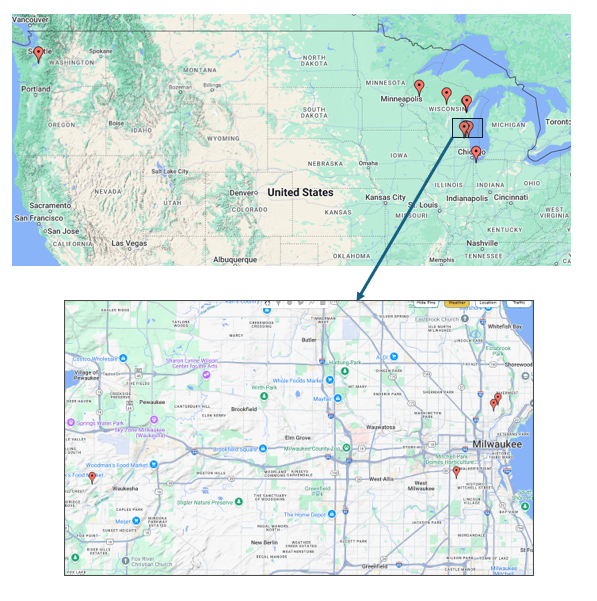
On January 5, 2025 the CBTE Term B began. The learners who began their studies in September continued with their next two courses. A new cohort of eleven learners also began their studies. Eight learners started a new entirely online cohort, and three students started the first Milwaukee-based cohort. The Milwaukee-based cohort will meet weekly as part of their Biblical Literature and History courses at the St. Marcus North Campus. We look forward to supporting our returning and new learners as they study to serve in the public ministry of the WELS.

Pausing at Christmas

There is much to celebrate.

We are quickly approaching the celebration of our Savior’s birth. Our churches, schools, and homes are filled with the joyful preparations and comforting traditions of our Christmas season. One of our family’s traditions is to share an Advent Devotion after we have finished our evening meal. It is a moment to pause and reflect on the greatest gift we have received through Grace alone, by faith alone.

We are quickly nearing the end of our first CBTE term, preparing for the second term, and completing the enrollment process for our second CBTE cohort to begin their classes in January 2025.

We are all looking forward to several weeks of a break. However, a pause between terms does not pause our most important work, strengthening our faith in the promise fulfilled through Jesus’ birth, life, death, and resurrection.

Thank You!

Thanksgiving 2024


Together we pray. Dear Savior, thank you for your suffering and dying for us on Calvary’s cross. We thank you for taking the guilt, the curse, and the punishment for our sins. We thank you for your victory over the grave and all it brings to us. We thank you, Lord, for your perfect substitution. Now help us appreciate the blessings we have because of your death and resurrection. Help us demonstrate our thankfulness by our actions and service—not just our words. Help our actions direct others to you, their Savior. Amen.

WELS. “We Thank you, Lord. ” Prayers.


Lessons Learned at CBExchange 2024

We missed posting a blog entry last week because the Nontraditional Education Program’s Instructional Designer and Director were away attending CBExchange, the annual international conference on competency-based education.

When they attended last year, MLC was at the beginning stages of our work with competency-based education. We were not yet approved to offer the CBTE Minor and were still working through the approval process with the Minnesota State Office of Higher Education for the APPLE Elementary Education degree. Our submission of the APPLE El Ed program to the Higher Learning Commission could not move forward until we had approval from the Minnesota Office of Higher Education. We had a growing list of interested learners, but we could not accept applications or enroll learners. We had ideas, but we had little implementation.

What a difference a year has made!

We returned this year with the CBTE Minor approved and with our first cohort of learners enrolled in their courses. We are one step away from approval of the APPLE El Ed program and hope to be able to begin offering courses in that program next year.

The sessions were far too rich to capture everything we learned, but we thought we would share a few of the big takeaways that will inform our work as we continue to build our competency-based education programming.

  • CBTE and CBE administrators, faculty, and staff are very giving of their time and talents. Some of the best sessions we attended gave us time to share out our progress and stumbles to learn from one another. Both the Instructional Desginer and the Director have planned follow up meetings with several colleagues at other institutions.
  • CBE-Network, the organization that sponsors the conference, emphasized its commitment to building partnerships with federal, state governments and higher education organizations. We look forward to attending sessions throughout the upcoming year through the CBE-Network to learn more.
  • Our Instructional Designer attended several sessions about our learning environment, D2L Brightspace. He scheduled follow-up meetings with our D2L support team to find out more about several features and options to support our course development.
  • Our Director attended several sessions on project management and models for supporting learners in CBE courses and programs. The insights from these sessions will help us as we scale our program and add new cohorts of learners in future terms.

The time away from campus at this conference was well spent.

Impact of CBTE Courses

If you are prayerfully considering applying to join an upcoming cohort of learners in our CBTE course of study, you may have questions about the impact or value of this program.

The value of studying at MLC is far greater than you may imagine.

Christ is at the center of our courses on campus, online, and in our new competency-based education course of study. The value of any course of study at MLC is that it leads to a closer relationship with our Savior, Jesus Christ.

The year-long focus on the Bible through Biblical History and Literature I, II, and III guides us in reading Scripture Christocentrically. By partnering these classes with Christian Doctrine I, Christian Doctrine II, and Lutheran Confessional Writing, we develop an understanding of the connection between the Bible and our past, present, and future as a Confessional Lutheran church body.


Each learner will have their own experience, but we thought a statement from one of our current learners might help you understand that these courses are more than classes at a college. They are an experience that can deepen your faith. 

I need to share with you how life-changing this experience has been for me as a Christian. I feel like I am building a better relationship with God, and I am building confidence in my worship and knowledge of God’s Word because of this opportunity in your program. My wife and I have had great conversations about God, and how we can grow together as Christians. I feel truly blessed, and want to thank you for helping me be a better Christian. — Cameron Cudnohowski, CBTE 202425A Cohort

MLC Faculty and CBE: VP Schone

CBTE – What Does That Mean?

Acronyms are pretty prevalent across the synod and our campus. LES? Lutheran Elementary School. ALHS? Area Lutheran High School. BIC? Bible Information Class. DP? District President.

As we build our CBE (competency-based education) programming at MLC (Martin Luther College), we are adding a few new acronyms to our WELS (Wisconsin Evangelical Lutheran Synod) vocabulary.

If you have spent any time on our webpage, you will have seen CBTE. Our first approved competency-based program is the CBTE Minor. While our CBTE Minor is uniquely framed to meet MLC’s institutional mission, CBTE is not something we devised. The international Competency-Based Theological Education movement reflects over a decade of work in rethinking how seminaries, colleges, and universities support the theological education of those preparing to serve in the ministries of various church bodies.

The International CBTE Community of Practice defines seven key practices that distinguish CBTE from traditional methods of theological training. We’ve used these seven guiding principles to develop MLC’s CBTE Minor.

Contextual Learning

Developing returning adult learners for ministry necessitates that they are involved in ministry. Going beyond an internship that constitutes part of their degree program, most CBTE learners are immersed full-time in their ministry environment. Assignments and learning opportunities are outcomes-based and, therefore, can be adapted to fit and contribute to the learner’s ministry context.

Partnered Investment

Having learners immersed in a ministry environment transforms the program from being primarily a service contract between the learners and the institution to being a partnership in developing leaders between the institution, the learner, and their congregational school.

Team-Based Mentoring

Diverse mentor teams are engaged to holistically develop learners. They work as a team to develop students in all areas of their lives. Mentor teams at MLC include:

    • A faculty mentor – an MLC faculty mentor who connects the learner with MLC resources
    • The CBTE faculty – the individuals who actively engage with the learners in their year-long study, and
    • A practitioner mentor – an on-the-ground mentor from the learner’s ministry context

Integrated Outcomes

To ensure holistic development, the program is designed with integrated outcomes that aim to develop learners in all areas of their lives. They integrate what you do, where you do it, and how you do it to understand what it means to be a called worker in the public ministry of the WELS.

Timely Instruction

By the end of a CBTE program, all learners will have demonstrated achievement of the same set of standardized outcomes. However, the context in which those outcomes are achieved is highly individualized. This promotes “just-in-time” learning, immediate application, and the opportunity to deepen learning through reflection.

Recognition of Prior Learning

Learners in MLC’s CBTE program come with prior education and experience. Like our traditional program, MLC’s CBTE program grants advanced placement to learners who have completed accredited courses similar to those in the program; credits given for prior credits earned. Learners who previously completed coursework at Bethany Lutheran College, Wisconsin Lutheran College, or Martin Luther College may be able to apply that coursework to their CBTE studies. Additional credits from other accredited institutions are applied to the General Education and program-specific curriculum if the learner continues in their studies at MLC.

Rigorous and Adaptive Assessment

The rigor of a CBTE program rests on its ability to effectively assess learners. Standardized outcomes and indicators are clearly defined and provided to mentors and learners. Mentor teams use these rubrics to understand a learner’s strengths and prior learning on program entry, so they can focus energy on maximizing strengths and shoring up weaknesses. Continual assessment throughout the program ensures that learners complete their course of study only when they have demonstrated mastery in each competency and are fully equipped to serve their ministry context.


The content included in this blog is based on the Competency Based Theology Education Conference.  (2024, October 22). What is CBE?